
How a steel home resists fire.
After the Eaton and Palisades fires, this is the question that matters most, and it deserves a straight answer, not a marketing one. Here's what non-combustible steel framing does, what it doesn't, and how the whole home works together.
Short answer: light-gauge steel is non-combustible, so the frame of your home does not ignite, burn, or add fuel to a fire. That directly attacks how homes are actually lost in California wildfires, wind-driven embers igniting combustible framing. But no building is fireproof. Real fire resilience is the non-combustible steel structure plus Chapter 7A-compliant cladding, roofing, vents, and windows, all working together.
It starts with embers
Most homes in a wildland-urban interface fire aren't lost to a passing wall of flame. They're lost to wind-driven embers that land on and in the structure and smolder into ignition, often hours later.
Wood framing is fuel
When those embers reach combustible framing, decking, or vents, they have something to catch. The frame becomes part of the fire. That's the chain that takes out home after home on the same block.
Steel breaks the chain
A non-combustible steel frame doesn't ignite or feed the fire, so the framing is removed from the fuel chain entirely. The embers land on a structure that gives them nothing to burn.
Most homes lost in California wildfires are ignited by wind-driven embers, not direct flame contact. Non-combustible framing attacks that exact failure mode.
Not a claim, a real outcome
A LyteMods steel ADU that stood through the Eaton fire.
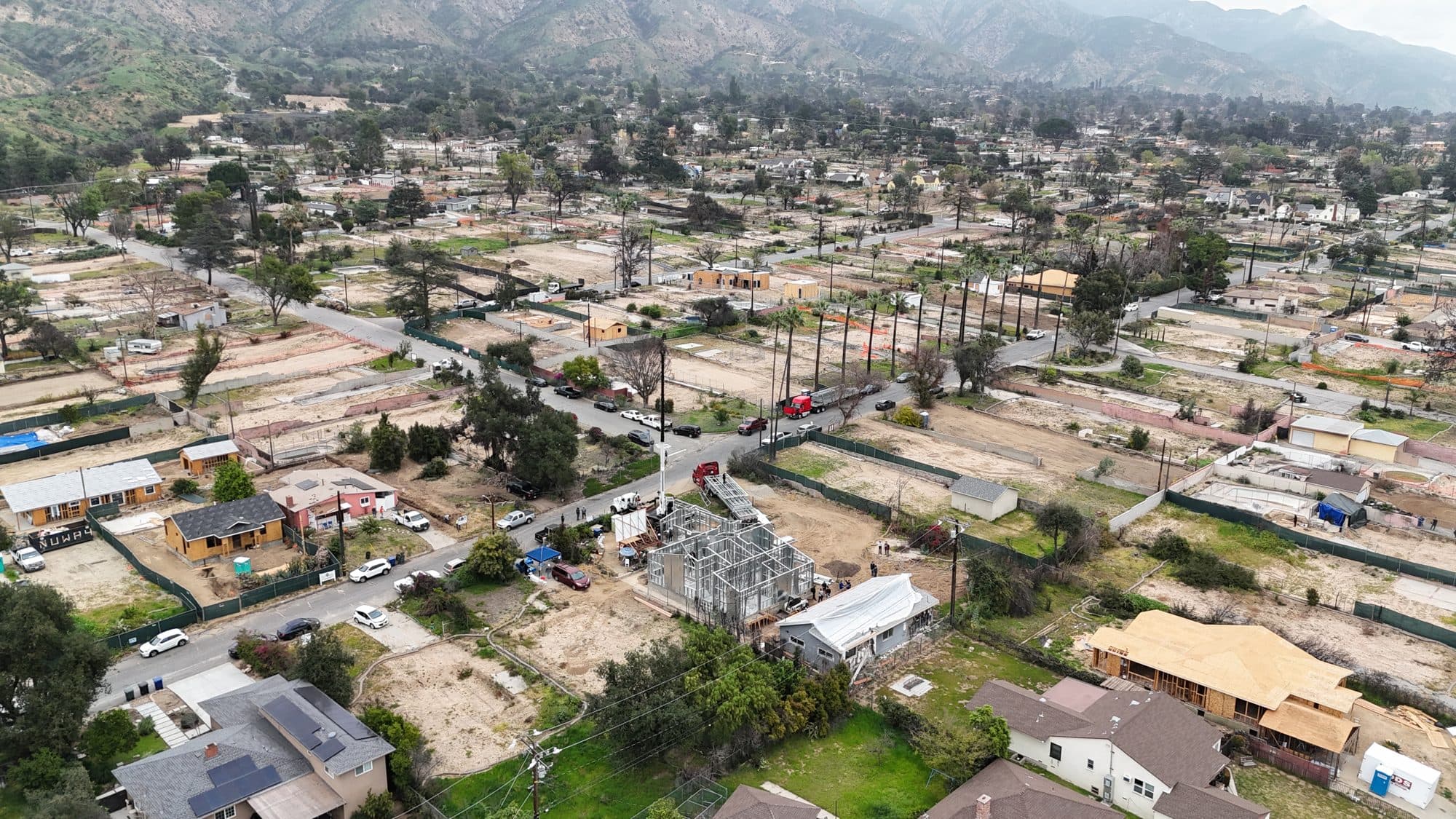
At our 480 W Palm site in Altadena, an original LyteMods light-gauge steel ADU came through the Eaton fire standing. It took damage and needed repairs, but the non-combustible steel structure did its job while the fire moved through the neighborhood. This is the same framing we build every home on.
Two lines of defense
A frame that won't burn, inside an envelope embers can't catch on.
Most fire-hardening only addresses the envelope, the outer shell embers land on. That work matters, but behind a hardened shell, a wood-framed home still holds a full body of fuel. LyteMods hardens both. Every home starts with a non-combustible steel frame, and in a fire-rated rebuild zone we wrap it in the full WUI fire-hardening package, so there is nothing outside for embers to catch on and nothing inside to feed a fire.
Line one, the structure
The frame that won't burn.
Every LyteMods home is framed in light-gauge steel. It is non-combustible, so the structure itself is removed from the fuel chain. Even if fire ever breaches the envelope, the bones of the house give it nothing to burn, and the frame will not warp, rot, or feed the fire the way dimensional lumber does.
Non-combustible light-gauge steel structure
Line two, the envelope
The envelope embers can't catch on.
In a fire zone the steel frame is wrapped in a full WUI fire-hardening package, standard in a fire-rated rebuild zone and an optional upgrade elsewhere, so wind-driven embers land on surfaces built to resist them:
- Class A fire-rated roof and fire-rated siding
- Fire-rated exterior doors and multi-paned tempered Low-E windows
- Ember-resistant eave vents with enclosed, protected eaves
- Interior fire-sprinkler system
- Non-combustible porches and decks
- Metal rain-gutter system and wired smoke and CO detectors
We don't publish a specific fire-resistance rating for a wall, because an honest rating only applies to a specific tested assembly. What we can say plainly: your home starts with a frame that will not burn, and we build the fire-rated assemblies around it.
Common questions
Is a steel-framed home fireproof?
No, and no honest builder should say a home is fireproof. Steel is non-combustible, meaning the frame does not ignite, burn, or add fuel to a fire, but fire resilience is a whole-home outcome. It comes from the framing working together with fire-rated cladding, roofing, vents, windows, and defensible space. Non-combustible steel removes the frame from the fuel chain; the assembly around it does the rest.
How are most homes actually lost in a California wildfire?
Not usually to a wall of flame. In wildland-urban interface fires, most homes are ignited by wind-driven embers that land on and in combustible framing, decking, and vents and smolder until they catch. A non-combustible light-gauge steel frame takes the framing itself out of that ember-to-ignition chain, which is exactly the failure mode that destroys neighborhoods.
What is Chapter 7A and does a steel home meet it?
Chapter 7A is the section of the California Building Code that sets materials and assembly requirements for homes in wildland-urban interface (WUI) fire areas, covering cladding, vents, decking, and windows. Light-gauge steel framing is compatible with Chapter 7A-compliant assemblies, and LyteMods homes are designed to pair the non-combustible steel structure with those rated assemblies.
Does steel lose strength in a fire?
Steel can lose strength at very high sustained temperatures, which is why fire performance is always evaluated at the assembly level, not by the frame alone. That's the honest engineering answer, and it's why fire resilience is designed into the whole wall, roof, and cladding system rather than claimed for the studs on their own.
Rebuilding after the fire?
We're already rebuilding in Altadena and the Palisades. See how the fire-rebuild program works, or start with a free site and insurance-scope assessment.