
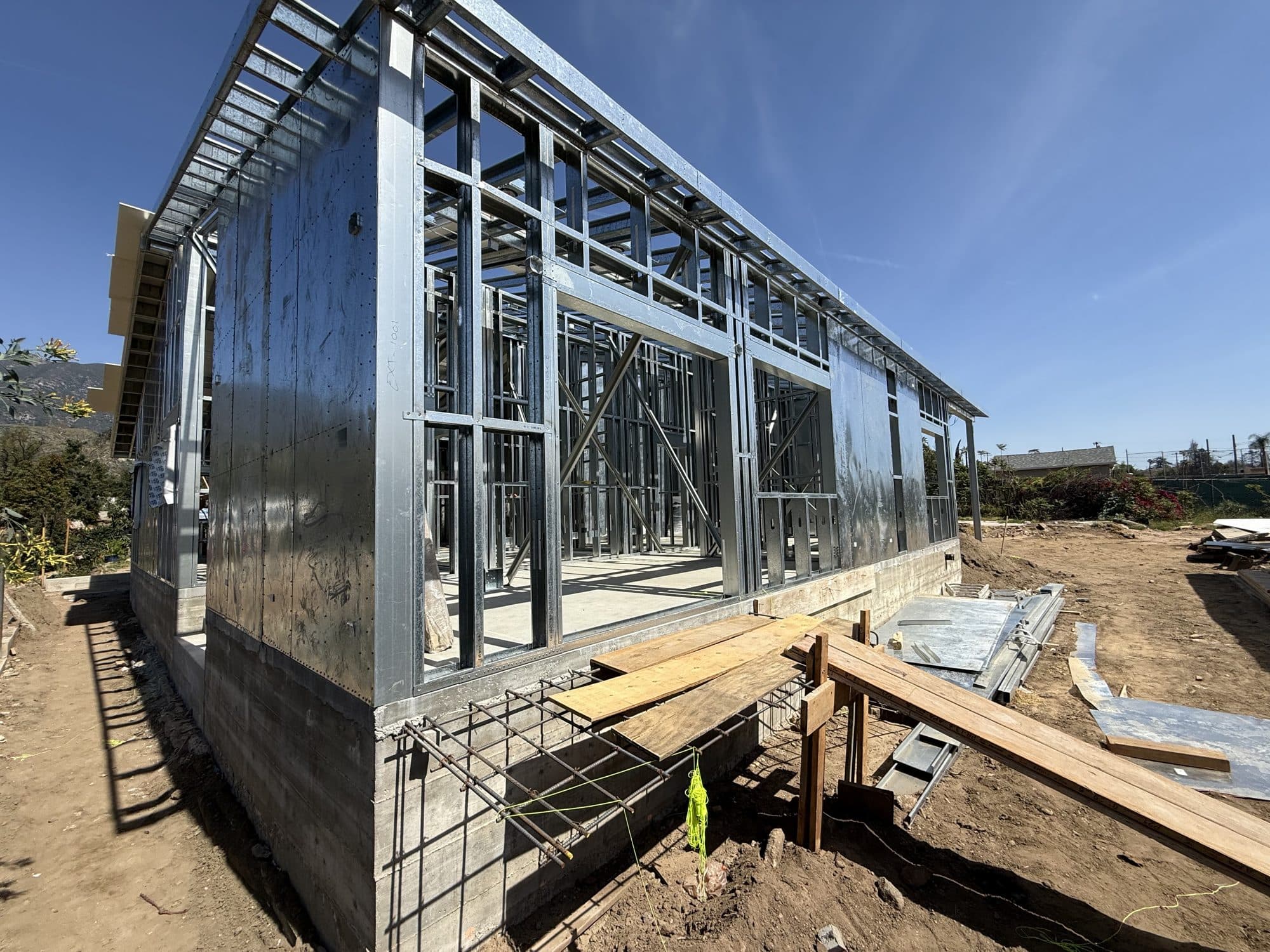
Steel vs. wood framing, honestly.
Wood built most of California, and it isn't going away. But for a home you plan to keep, especially in a fire-prone area, light-gauge steel changes the trade-offs. Here's the straight comparison, including where wood still makes sense.
Short answer: light-gauge steel framing is non-combustible, dimensionally stable, and immune to termites and rot, and it's well suited to factory prefabrication that holds a schedule. Wood is often cheaper up front and every crew knows it, so it can win on small, simple builds in low-risk areas. For fire safety, longevity, and consistency, steel pulls ahead, which is why LyteMods frames every home in it.
Side by side.
| Consideration | Light-gauge steel | Wood framing |
|---|---|---|
| Fire | Non-combustible, adds no fuel to a fire | Combustible, burns and feeds fire |
| Termites & pests | Inorganic, nothing to eat | Vulnerable, needs treatment and monitoring |
| Rot & mold | Won't rot; no food for mold | Can rot and support mold when wet |
| Dimensional stability | Won't shrink, warp, twist, or split | Shrinks, warps, and can twist over time |
| Consistency | Roll-formed to tight, repeatable tolerances | Varies board to board |
| Schedule at scale | Suited to factory prefab and parallel site work | More on-site, weather-dependent labor |
| Material cost | Higher per pound, but more stable pricing | Often cheaper, but prices swing widely |
| Familiarity | Fewer crews trained on it locally | Every framer knows it |
A checkmark marks where steel has the structural advantage. The last two rows are where wood can still win, we'd rather tell you that than pretend otherwise.
Common questions
Is a steel-framed home more expensive than a wood one?
The honest comparison is total delivered cost, not the price of the raw material. Steel can cost more per pound, but its pricing is far more stable than lumber, which swings widely with the market, and factory prefabrication saves time and reduces waste and rework. On a fire-rebuild or a home you plan to keep, steel's durability and lower maintenance change the long-run math. We keep specific pricing to your actual project rather than quoting a blanket number.
Is wood ever the better choice?
Being honest, wood is not obsolete. On a small, simple, single-story project in a low-fire-risk area, conventional wood framing can be the pragmatic choice. Steel pulls ahead when fire safety matters, when a schedule needs to hold, when a design repeats, or when you want a home that stays straight and pest-free for decades. In California's fire-prone areas, that's most of the time.
Do steel-framed homes last longer than wood?
A steel frame doesn't rot, warp, or feed termites, so the structure itself is extremely durable. Galvanized and sealed inside a dry, insulated wall, it holds its shape and strength for the life of the home, which is why the same material frames commercial buildings meant to stand for generations.